



Quick Answer: Rental yield is the annual rental income a property generates, expressed as a percentage of its purchase price or current market value. It helps UK landlords assess potential buy-to-let returns and compare investment properties. Gross rental yield measures income before expenses, while net rental yield accounts for running costs such as maintenance, insurance and management fees. Understanding both helps landlords make informed property investment decisions.
Rental yield measures how much annual rental income a property generates compared with its purchase price or current market value. It helps landlords understand potential income returns, compare buy-to-let investments and assess whether a property is financially worthwhile.
However, rental yield alone does not tell the whole story. Mortgage costs, maintenance, void periods, taxation and potential capital growth all influence an investment’s overall performance.
At Parkgate, we help landlords across Putney, Richmond and South West London assess achievable rental income through local market knowledge, rental valuations and property management.

What Is Rental Yield and Why Does It Matter?
Rental yield is the annual rental income from a property expressed as a percentage of its value. It provides a standard way to compare the income potential of different properties, even when their purchase prices vary considerably.
For example, a property generating £18,000 in annual rent and valued at £300,000 has a gross rental yield of 6%.
Landlords use rental yield to:
- Compare potential buy-to-let properties.
- Assess whether asking rents justify purchase prices.
- Evaluate income performance across a property portfolio.
- Identify whether operating expenses are reducing returns.
- Support decisions about retaining, improving or selling an investment.
A higher yield can indicate stronger income relative to property value, but it does not automatically mean a better investment. Property condition, tenant demand and financial risk also matter.
How Do You Calculate Gross Rental Yield?
Gross rental yield is calculated by dividing annual rental income by the property’s purchase price or current market value, then multiplying by 100. It measures rental income before deducting operating expenses, mortgage costs or tax.
Gross rental yield formula
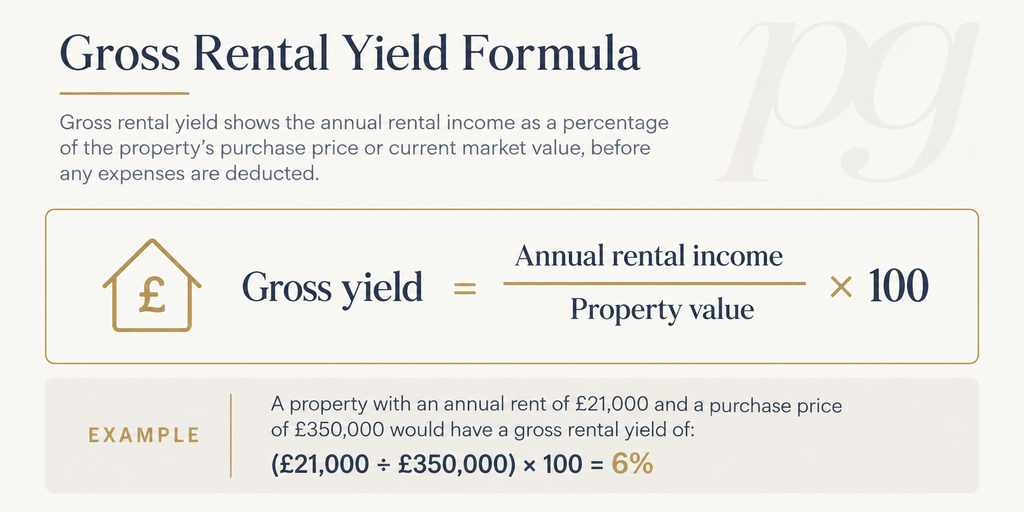
The gross rental yield is 6%.
This gives investors a quick snapshot of potential rental income. However, it assumes the property generates the full annual rent and does not account for expenses.
For consistency, compare properties using the same valuation basis. Purchase price is useful when assessing acquisition decisions, while current market value can help existing landlords review the income return on their property today.
How Do You Calculate Net Rental Yield?
Net rental yield measures annual rental income after deducting specified property operating expenses, expressed as a percentage of property value. Unlike gross yield, it accounts for costs such as maintenance, insurance and management fees, providing a more realistic indication of operating income.
Net rental yield formula
Using the same £350,000 property, assume these illustrative annual expenses:
| Expense | Annual cost |
| Property maintenance and repairs | £1,200 |
| Letting and management fees | £1,800 |
| Landlord insurance | £350 |
| Service charges | £1,000 |
| Allowance for rental voids | £1,750 |
| Total | £6,100 |
Annual rental income: £21,000
Annual income after these costs: £14,900
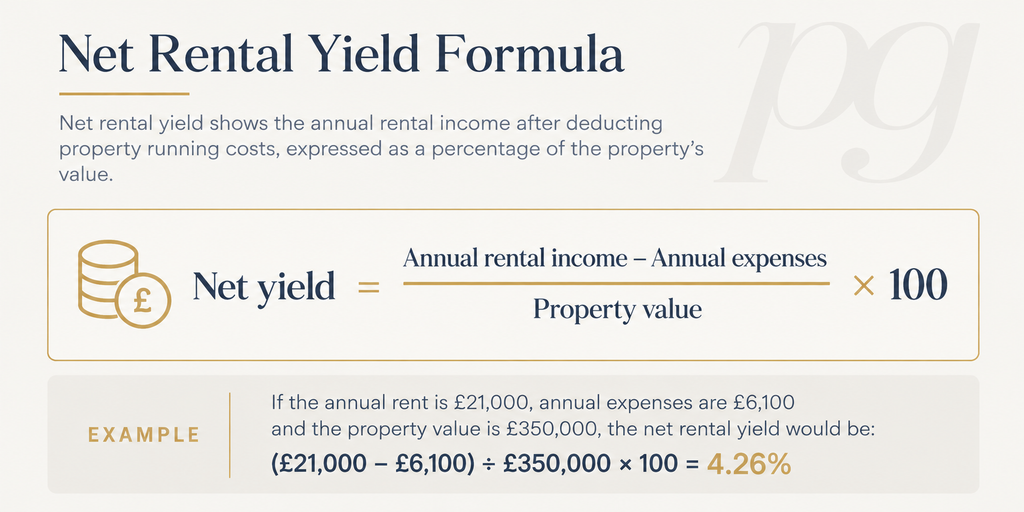
The property’s illustrative net rental yield is 4.26%, compared with its 6% gross yield.
This calculation excludes mortgage finance, acquisition costs and tax. Different calculators may define net yield differently, so landlords should always check which costs are included. A void allowance should not be deducted twice if actual rent received already reflects the vacancy.
What Is the Difference Between Gross and Net Rental Yield?
The main difference is that gross rental yield measures income before expenses, while net rental yield accounts for defined property running costs. Gross yield is useful for initial comparisons, whereas net yield provides a clearer indication of the income a landlord retains before financing and tax.
| Gross rental yield | Net rental yield |
| Uses annual rent | Uses rent after operating costs |
| Simple to calculate | Requires annual cost estimates |
| Useful for screening properties | Useful for assessing operating performance |
| Can overstate available income | Better reflects ongoing maintenance costs |
For a meaningful investment assessment, calculate both gross and net yields. Gross yield identifies income potential; net yield highlights how ongoing costs, including letting or property management costs, change that potential, and other costs may also apply depending on the property.
Which Landlord Expenses Affect Rental Yield?
Rental property expenses reduce the income retained by landlords and therefore affect net rental yield. These are the key factors behind the gap between headline income and what a landlord actually keeps. Typical costs include repairs, property management fees, insurance, service charges, licensing and periods when a property is unoccupied. Landlords should calculate both gross and net yields when assessing a property.
Maintenance and refurbishment
Landlords should budget for routine repairs, servicing, redecoration and replacement of worn fixtures.
Major refurbishment projects may also require substantial investment. The extent of work, property condition, kitchens, bathrooms, plumbing, electrics and unforeseen repairs can significantly affect the overall cost.
Letting and property management fees
Letting agents may charge for tenant sourcing, referencing, rent collection or full property management.
These costs should be included when assessing net income. Professional management may also help landlords coordinate maintenance, manage tenancies and reduce avoidable disruption.
Insurance, service charges and compliance
Other potential expenses include landlord buildings insurance, leasehold service charges, applicable ground rent, safety inspections and property licensing.
Costs vary according to the property, tenure, location and applicable requirements.
Landlords should review their responsibilities under GOV.UK‘s landlord guidance.
Mortgage interest and taxation
Mortgage payments affect cash flow, but they are not always included in standard net yield calculations. Mortgage interest and capital repayments should be distinguished because repayments reduce outstanding debt.
Taxable rental profit is also different from rental yield. Individual landlords face specific restrictions on residential property finance cost relief, and improvements may receive different tax treatment from repairs.
HMRC explains these distinctions in its rental income guidance.
What Is a Good Rental Yield in the UK?
A good rental yield is one that produces sufficient income after costs while remaining appropriate for the property’s location, condition, financing and investment risk. In broad UK terms, the average rental yield is often between 5% and 8%, which is also commonly viewed as a good rental yield for many buy-to-let properties.
As an illustrative comparison, a property with a 7% gross yield may appear more attractive than one offering 4%. In the UK, yields above 6% are often considered very good, while prime areas such as central London may be closer to 3% to 5%. However, expensive repairs, inconsistent tenant demand or high borrowing costs could substantially reduce the higher-yielding property’s profitability.
Landlords should assess:
- Local rental demand and achievable monthly rent.
- Purchase price relative to comparable properties.
- Expected repairs and refurbishment requirements.
- Likely vacancy periods and tenant turnover.
- Mortgage affordability and interest-rate exposure.
- Long-term capital growth potential.
Average rental yields can provide market context, but national figures may conceal significant differences between individual streets and property types.
How Does Rental Yield Compare With Capital Growth, Cash Flow and ROI?
Rental yield measures income relative to property value, while capital growth measures changes in property value. Cash flow shows money remaining after actual payments, and return on investment (ROI) can incorporate financing and the investor’s capital contribution.
These measures answer different financial questions.
Rental yield versus capital growth
A property may generate a relatively modest rental yield but appreciate in value over time. Another property may provide higher rental income without experiencing comparable capital appreciation.
Neither outcome is guaranteed. Property values can fall, and selling costs and taxation may reduce realised gains.
Rental yield versus cash flow
A landlord can achieve a positive net operating yield while experiencing negative cash flow after mortgage payments and other commitments.
For example, if a property generates £14,900 after operating expenses but requires £16,000 in annual mortgage payments, its cash flow before tax and other excluded costs is negative £1,100.
Rental yield versus ROI
ROI can assess returns against the investor’s actual capital contribution, including deposits and acquisition expenses.
For leveraged investments, financing can substantially change the relationship between rental yield and returns on invested cash.
Landlords should therefore review several financial measures rather than relying on one headline percentage.
How Do Location and Property Type Affect Rental Yield?
Location and property type influence both rental income and purchase price, making them important determinants of rental yield. A flat, family house or student property can produce different returns because tenant demand, maintenance requirements and acquisition costs vary. Yields also vary by location because lower property prices relative to rent can lift returns, while areas with higher house prices often see lower average yields.
In South West London, landlords should assess individual properties rather than assume that every home in the same postcode offers a similar return. Nationally, Sunderland, Dundee, and Burnley record highest rental yields at around 8%, and some lower-priced regional markets in the North East, North West, Northern England, or Scotland can exceed that.
Rental yields in Putney and Richmond
Putney’s rental market includes riverside apartments, smaller flats and family homes. Richmond, Sheen and Mortlake also offer varied housing stock serving different tenant requirements.
Transport connections, property condition, bedroom numbers, outdoor space and local amenities can all influence achievable rent.
For landlords considering a buy-to-let investment in SW15, our Putney landlord guide explains the local letting process.
Why rental valuations matter
An accurate rental valuation helps landlords estimate achievable income using comparable properties, rather than relying on optimistic advertised rents or broad regional averages.
At Parkgate, our Putney property valuation service can help establish a realistic starting point for rental income calculations.
How Can Landlords Improve Rental Yield?
Landlords can improve rental yield by increasing sustainable rental income, reducing unnecessary operating costs and limiting avoidable vacancies. The most effective approach depends on the property’s condition, tenant demand and the cost of any proposed improvements.
Practical options include:
- Review the asking rent. Compare similar properties and current market conditions before adjusting rental expectations.
- Reduce avoidable void periods. Prepare and market the property effectively while allowing sufficient time to find suitable tenants.
- Maintain the property proactively. Address smaller maintenance problems before they develop into more expensive repairs.
- Assess improvements carefully. Compare the cost of refurbishment with any realistic increase in rent.
- Review management arrangements. Understand fees, service levels and the administrative time involved in managing a tenancy.
Increasing rent is not always the best solution. An unrealistic asking price may prolong vacancy and reduce total annual income.
For landlords seeking support, our property management services in Putney cover tenant liaison, maintenance coordination and ongoing management.
How Can Parkgate Help Landlords Assess Rental Returns?
Parkgate helps landlords assess rental income through local market knowledge, rental valuations and lettings services across Putney, Richmond and surrounding South West London areas.
We understand that successful property investment involves more than calculating a headline yield. Realistic rental pricing, appropriate tenant selection, ongoing maintenance and effective tenancy management all contribute to long-term performance.
Our services include tenant sourcing, rent collection and full property management, allowing landlords to choose the support that suits their needs.
Whether you own an established rental property or are considering a new buy-to-let investment, a realistic rental assessment can help you plan with greater confidence.
Visit Parkgate Estate Agents to explore our services and discuss your property’s rental potential.
Frequently Asked Questions About Rental Yield
Is rental yield calculated monthly or annually?
Rental yield is normally expressed as an annual percentage. Multiply monthly rent by 12 to calculate potential annual rental income before applying the relevant yield formula.
Does rental yield include mortgage payments?
Gross rental yield excludes mortgage payments. Standard net operating yield calculations also commonly exclude financing, although definitions vary. Landlords should calculate mortgage-related cash flow separately.
Can rental yield change over time?
Yes. Changes in rent, property value, operating expenses and vacancy periods can all affect rental yield. Reviewing calculations periodically helps landlords assess ongoing performance.
Is a higher rental yield always better?
No. Higher yields may be associated with greater maintenance requirements, vacancy risks or weaker capital growth prospects. A balanced investment assessment considers both income and risk.
Should landlords use purchase price or current market value?
Purchase price helps assess the original investment, while current market value helps measure today’s income return relative to the property’s estimated worth. Use a consistent basis when comparing results.
Disclaimer: This article provides general property investment information and does not constitute personalised financial, tax, mortgage or legal advice. Rental returns are not guaranteed. Landlords should seek guidance from appropriately qualified professionals before making investment or taxation decisions.
GOOGLE REVIEWS